New Mazda 3 Revealed

Having faced stiff competition from the likes of the Hyundai i30, Toyota Corolla, Kia Cerato and Ford Focus in recent years, the next-gen Mazda 3 has been reoriented for a more premium position in the market.

Having faced stiff competition from the likes of the Hyundai i30, Toyota Corolla, Kia Cerato and Ford Focus in recent years, the next-gen Mazda 3 has been reoriented for a more premium position in the market.

Reflecting customers’ moves away from the entry level model, this new offering brings luxury and safety to the forefront with a chic new exterior design and top of the line safety tech.

Now included as standard are a button start, seven airbags and upgraded tech like radar-guided active cruise control, blind-spot monitoring, rear cross-traffic alert, lane departure warning and front and rear autonomous emergency braking.

A new outward look

Thanks to a sleek new headlight and grille design and a C-pillar fitted at the rear, the bold new exterior has elicited a love or hate reaction. Slightly lower and shorter than the previous model, it still fits well into the ‘small car’ category, but with a sophisticated look you’d expect for a premium buyer.

All 5 options come in a range of standard colours, including ‘Snowflake White Pearl’, ‘Sonic Silver’, ‘Machine Grey’, Jet Black’, ‘Titanium Flash’ and ‘Deep Crystal Blue’. Metallics are available at an additional $495, with a choice of ‘Machine Grey metallic’, ‘Polymetal Grey metallic’ and the always popular ‘Soul Red Crystal metallic’.

18-inch alloy wheels are standard, and a subtle body kit’s also on offer with side skirts, a rear diffuser and front spoiler. A rooftop spoiler is standard on the hatch, with twin chrome exhaust standard on both hatch and sedan.

A chic interior view

Reflecting their new market position, all models now come with a head-up display, 8.8-inch screen, reversing camera, sat nav, Apple CarPlay and Android Auto, along with digital radio, Bluetooth and steering wheel mounted controls.
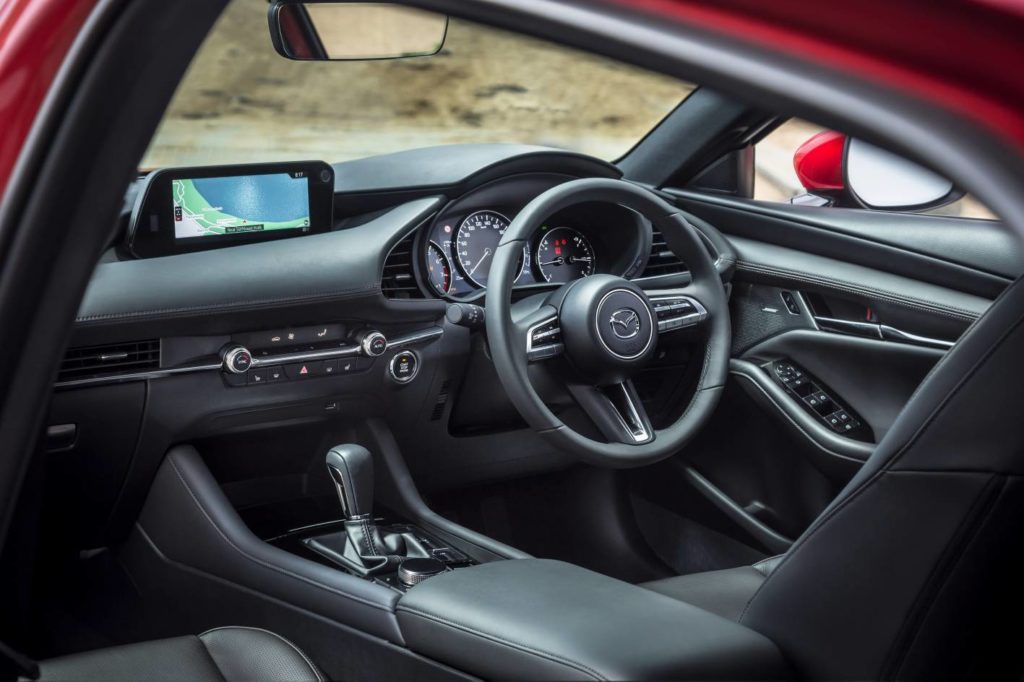
Reflecting their new market position, all models now come with a head-up display, 8.8-inch screen, reversing camera, sat nav, Apple CarPlay and Android Auto, along with digital radio, Bluetooth and steering wheel mounted controls.

The G24 GT and G25 Astina now also boast a 12-speaker Bose stereo, but the standard eight-speaker system on the remaining grades is certainly nothing to sneeze at.

Minimalist design is the order of the day in the interior, with high quality feel materials, a dark colour scheme and subtle climate and media control labelling. Cupholders have been moved and are now in front of the shifter, ushering in a longer centre armrest and a bigger console. The centre screen is also now slightly further away, allowing for a more streamlined ‘cockpit’ like feel.

Upgraded hardware and software supports a new infotainment system, ensuring better loading times, conversational voice control and a cleaner user interface.

A smooth, quiet drive

Previously criticised for noise and vibration, the new model employs 49 different noise and vibration reducing techniques. Sound-deadening, different seals and revised engine mounts and dampers reduce tyre and wind noise, resulting in a smoother, quieter ride.

Buyers can choose two engine types, the G20 and more powerful G25, and from five model types:

  • Pure
  • Evolve
  • Touring
  • GT
  • Astina

G20 models come with a 2.0-litre naturally-aspirated petrol-fired four-cylinder engine, with a choice of six-speed manual or six-speed torque-converter-type auto transmission. G25 models come with the current 2.5-litre petrol four, but with a low-stress cylinder deactivation system designed to reduce fuel use.

All Australian models will come with front-wheel drive and are covered by a five-year unlimited-kilometre warranty.

The new Mazda 3 hatch is on sale now, with the sedan driving into dealerships around July.

Time to upgrade?

If you are interested in learning more about the new 2019 Mazda 3 range or any other vehicles, the team at Platinum Direct Finance have extensive experience in sourcing car finance for personal and business use.

Speak to one of our expert consultants for an obligation-free quote today. Call Platinum Direct Finance on
1300 554 553 or visit our car repayment calculator and upgrade today.


Which car finance solution is right for you?

Navigating your car finance options can be a stressful and overwhelming experience. But it doesn’t have to be. Thanks to our simple guide on types of car finance, confident decision making is only a step away. Here’s all the information you need to get started.


When you need a car for personal use

Secured car loan

A secured loan is referred to as a ‘secured’ loan because the car you’re buying is held as security against the loan until it’s paid out. So if you miss or fall behind in your repayments, the lender can sell the car to recover the debt. Secured loans often come with lower interest rates and flexible repayment terms and are a good option when you’re buying a car purely for personal use and salary packaging isn’t an option.

Novated lease

Also referred to as salary packaging, a novated lease is a three-way arrangement between you, your car finance provider and your employer. Put simply, the financier buys the car and leases it to you. Your employer then takes a fixed, monthly payment from your pre-tax salary that covers your repayments, maintenance and running costs and pays it to the financier. At the end of the lease you can either sell or buy the car outright. Offering significant tax savings, they can be used for new or used cars intended for purely personal use.


When you need a car for business use

Chattel mortgage

Under a chattel mortgage, you borrow money from a lender to buy ‘moveable’ property – in this case, a car. The lender secures the loan against the car (much like a secured loan) and holds the mortgage until the loan is repaid. You can either finance the total purchase price or pay a deposit or use a trade-in to reduce the loan amount. Thanks to minimal capital outlay, flexible contract periods and significant tax advantages, it’s a great option for business owners.

Low doc loan

Low doc loans are particularly popular with sole traders or business owners who’ve been operating for more than two years and have been ABN registered for more than 18 months. Applicants for low doc loans don’t need to hand over all their financials and/or tax returns to have the loan approved, making it a great option for busy business owners. The pricing structure is like a full finance loan but remember you must be able to prove the vehicle is going to be used for commercial purposes.

Operating lease

Under an operating lease, the financier buys your vehicle and rents it back to you. Because the finance provider retains ownership of the car, you assume none of the risks associated with ownership, including the residual payment at the end of the lease period. You do however have the option to buy the car, continue to rent it, or change to another vehicle at the end of the lease. Your repayments are fixed over a set period and bonus, your rent is tax deductible too.

Speak to our Car Finance Experts today and they will help you decide on what type of car finance is best suited to you.

Instant asset write off scheme increased to $30,000

Thanks to an extension to the instant asset write off scheme, businesses all over Australia are set to benefit this EOFY. And with thresholds increased from $20,000 to $30,000, there’s never been a better time to invest in your business. Here’s what’s on offer and why the lead up to tax time is the best time to buy.

A three-tier scheme

The write-off scheme now consists of three tiers with an expanded eligibility for larger businesses. Here’s the breakdown:

Tier one

The first tier covers depreciable assets acquired before 29 January 2019, with a threshold limit of $20,000.

Tier two

Tier two has a slightly higher threshold of $25,000 and covers assets first used or installed ready to use between 29 January 2019 and 2 April 2019, up until the scheme cut-off date of 30 June 2020.

Tier Three

The third tier increases the threshold again to $30,000 for assets first used and installed between 2 April 2019 and 30 June 2020.

The scheme was previously reserved for smaller businesses turning over less than $10 million a year, but has been widened to include those turning over less than $50 million per year. Eligible businesses will be able to claim the write-off every time they purchase an asset under the applicable threshold cap.

What do the changes mean for you?

It’s pretty simple – buy an eligible asset under tier 1, 2 or 3 and you can immediately write the purchase off on tax (there are of course some conditions, so check out the ATO’s website for the full story). So whether you need a car, ute or business equipment, from now until June 30 is a great time to buy.

Ready to invest in your business?

We’d love to help you out. We can help you arrange finance for the purchase of all kinds of business equipment, from small ticket items like phones and computers, right through to the big stuff like vehicles and heavy machinery. To explore your options, give the Platform Direct Finance team a call on 1300 554 553.

For more information speak to your accountant or visit the ATO website.

Everything you need to know about balloon payments

When you’re navigating the sometimes tricky world of car finance, terms like ‘balloon payment’ can really throw you for a loop. If you’re thinking about getting finance to buy a new car, these are just some of the simple facts you need to know.

What is it?

A balloon payment – also known as a residual payment – is a once off lump sum payable to your financier at the end of your loan term. It’s calculated based on the depreciated value of your asset at the end of your loan and may be represented as a dollar figure or as a percentage of the total amount borrowed.

Why might you want one?

By attaching a balloon/residual payment to your car loan, you decrease the amount payable each month. By reducing your monthly repayments, you can potentially take out a larger loan and upgrade to a vehicle you may not have been able to afford if you were buying outright.

When is it payable?

Balloon payments are due at the end of the loan and must be paid in a lump sum. However, subject to approval, you can also refinance or ‘roll over’ the payment into a new loan, or sell or trade in your vehicle and use the proceeds to pay out the balloon payment and/or refinance a new loan.

What are the limits?

The size of your maximum balloon or residual payment depends on a range of factors and may include the age of the vehicle being purchased, the loan term, the type of loan and the borrower’s financial profile.

Ideally, you want your balloon payment to be less than or equal to the value of the vehicle when the balloon payment is due. That way, if you want to get a new vehicle at the end of the loan, you won’t be left out of pocket (and may even come out with a deposit to put towards your new vehicle).

Want to know more?

At Platform Direct Finance, we’re experts in car financing and can tell you everything you need to know about balloon repayments. Browse our website or get in touch to learn more.

Cashflow tips for tradies

As we move into the back end of the financial year, tradies and suppliers should be looking to balance their books. But since cash flow is the lifeblood of business, you need to make sure you’re managing your money.


Here are seven tips to master your cashflow:

1. Go digital

The trend of managing money on your tablet is unlikely to slow. There are myriad apps and software options to help you keep track of your cashflow, and they are designed to be user-friendly and easy to adopt. Use the technology to update invoices in between jobs and access options such as automatic invoicing and payment reminders for customers.


2. Fixed expenses

When it comes to fixed expenses such as loans, rent, and scheduled maintenance there should be no surprises. The big message here is to be aware of your cash inflow and outflow. Keep track of upcoming expenses including the amounts and their due dates to ensure funds are ready to meet regular expenses. Check in on your budget to ensure it stays on track.


3. Variables

Have a little slack in your budget to prepare for variable expenses. Consider unexpected costs such as extra payments to subcontractors, extra materials and shipping costs in your budget. Your variable expenses will increase relative to workload – the more work you have, the more variable costs incurred. For costs impacted by market forces such as insurance, it’s important to understand the likely increase in what you are paying this year compared to next year’s price. Financial advisers and brokers are a good source of information on market conditions.


4. Cash reserves

Cash reserves are critical. Keep any extra reserves in interest-earning accounts for emergencies – you’ll be giving yourself a financial high-five when the unexpected happens. Maintain another cash reserve for bills and unexpected shortfalls, which can be dipped into when the cashflow tide is low.


5. Out-of-pocket expenses

Drowning in receipts? Most software now has a mobile app that allows you to scan, upload and categorise your receipts for out-of-pocket and claimable expenses. Don’t wait until the end of the quarter to pull together your receipts from a shoebox. Keep on top of them and save yourself valuable time to ensure you get as much back as you can.


6. Invoice. Now.

Don’t wait. The faster an invoice is paid, the faster you have cash flowing back into the coffers. Encourage swift collection of payment in your business by invoicing straight after job completion.

Make it easy for your customer to pay by offering a variety of payment options such as direct debit or – even better – take cash on delivery. Payment terms and conditions and late payment interest penalties must be set out in your contract or quote with your customer. Ensure that these are made clear to your customer before beginning the job so they don’t fall foul of unfair contract term laws.


7. Know thy customer

Taking on new customers is always win. But you want to make sure they can pay. For new customers, large jobs or long-term contracts, ask for a deposit or set up a payment schedule. This goes for repeat customers who have a history of late payments. Don’t wait to chase them up. Contact lax payers upon invoicing and discuss options for payment.


Cashflow keeps the wheels of the supply chain turning. If you don’t get paid, then you can’t pay the subcontractor who then can’t pay for materials and the effect goes on.

Put these tips into practice to maintain positive cashflow throughout the year.

This article was originally published by OneAffiniti.com 

The new Triton gets Tougher

Mitsubishi has ditched what it described as a ‘sporty design’ for the Triton mid-size ute and opted for what it calls a tougher-looking truck for 2019.

A midlife update usually brings some design tweaks to the grille and bumper, but Mitsubishi has gone a few steps beyond this with its MY19 Triton ute that arrives less than four years into the current version’s life cycle.

The company has completely redesigned the front, adding its familiar ‘dynamic shield’ face and making the side-view more buff. It’s prouder, bolder and more macho, which is exactly what ute buyers want.

The passenger cabin remains the same, but all the exterior metal has been replaced with a bolder, boxier design which brings the Triton into line with more modern elements of the Mitsubishi line-up. There are also four new colours, including a pearlescent white, a burnt orange and a flat red.

Mitsubishi’s Best Seller

Mitsubishi’s Triton ranks third in the new-4×4 sales race behind the Toyota HiLux and Ford Ranger – Australia’s best-selling vehicles in 2018 – which is an impressive result considering competition such as the Colorado, Nissan Navara, Isuzu D-Max and VW Amarok.

Price is core to the appeal of Triton. Mitsubishi can credit its sales to heavy discounting and great drive-away deals that have always made the Triton a good value-for-money vehicle for both private and fleet buyers, but it’s not a cheap, stripped-out vehicle. It entices practical value-shoppers who’ve long loved the Triton’s price tag and reliability.

Interior Specs 

The layout of the cabin isn’t much different, though there is some extra stitching and silver plastic inserts scattered about. Higher grades also get roof-mounted air vents. Plus, rear passengers will be happy with two USB points for the back seat, a new storage area, and a B-pillar-mounted grab handle to help you climb up.

The dash is home to a 7.0-inch touchscreen with Apple CarPlay/Android Auto. There’s also a neat 360-degree overhead camera like the Navara’s available, but with better resolution.

Under the bonnet

The engine is familiar, a 2.4-litre turbo-diesel. Power is 133kW at 3500rpm and maximum torque is 420Nm at 2500rpm. The tow rating remains 3.1 tonne.A major replacement is the axing of the old five-speed automatic gearbox in favour of a new six-speed unit.

Other new tech in the 2019 model includes a suite of driver’s aid technologies such as Forward Collision Mitigation (FCM/AEB), Blind Spot Warning and Ultrasonic Misacceleration Mitigation System which cuts engine power if you accidentally move forwards or backwards from standstill towards an object and don’t brake (perhaps engaging R instead of D, for example). There is also a stop/start system to cut fuel use and improve emissions

Time for a new set of wheels?

If you are interested in learning more about the new 2019 Mitsubishi Triton or about the ins and outs of car finance for any make or model, contact one of our expert consultants today.

Revamped 2018 Ford Mustang

Now with a 10-speed automatic, revised styling, more power and a nastier exhaust note, the new Ford Mustang is tougher than it was.

Louder, prouder – Ford has updated their V8 Mustang, introducing a host of changes for 2018 that improve the appeal of its coveted muscle car. Already the most popular sports vehicle on sale in Australia, the midlife facelift uncovers more speed, dynamics, tech and safety.

First up, appearance. The new model boasts a reshaped bonnet and has gained some air vents. There’s a 60mm broader grille, plus countersunk ‘eagle eye’ all-LED headlights. The remodelling in the rear is subtler: techier-looking LED taillights and quad exhaust tips. Less muscle car, more motorsport effect, then, but from the rear this is a tougher looking car.

The interior of the Mustang has never been built to high-street opulence, it’s materialistically modest and has been built-to-cost since the 1960s. This helped it retain its nice level of American-tinged kitsch, rather than a premium Euro-look. One noticeable upgrade is the all-digital 12-inch digital instrument cluster with countless personalisation menus. The modest 8-inch centre touchscreen has been upgraded to Sync3 software with Apple CarPlay and Android Auto, while a reversing camera and sat-nav are both standard.

This new GT absolutely roars because, according to Ford, customer feedback made it clear the outgoing V8 was way too quiet. But quiet can be cool. The adaptive exhaust’s Good Neighbour mode allows you to electronically preselect time-of-day parameters for the Mustang so it starts up in Quiet mode rather than the already-bellowing Normal setting.

The 2018 Mustang starts from $66,259 plus on-road costs, and despite the price hike with the new model, it still represents eyebrow raising bang-for-your-buck. The range includes the Mustang GT Fastback auto, GT Fastback manual and the top-end GT Convertible auto.

GT fastback features

  • Engine – 5.0-litre ‘Coyote’ V8 petrol
  • Maximum power output (kW/rpm) GT : 339 @ 7,000 rpm
  • 6-speed manual or 10-speed automatic
  • Automatic On-Off LED Headlamps with Automatic Levelling
  • Tyre Pressure Monitoring System (TPMS)
  • New optional Recaro seats
  • Active Exhaust Valve with four selectable modes
  • Sync3 software with Apple CarPlay and Android Auto

Limited Edition Ford Mustang Bullitt

Ford Australia has confirmed that 700 units of the limited-edition Mustang Bullitt will be coming to Australia in October.

Built to celebrate the 50th anniversary of the Steve McQueen film Bullitt (famed for its epic 10min car chase that stars a 1968 Mustang GT 390 fastback tearing up the streets of San Francisco), the Bullitt Special Edition will be offered in a new one-off colour; a Dark Highland Green that matches the tone of the movie car.

The new version is distinguished by Bullitt badging, a darkened front grille, gloss-black 19-inch ‘Torq Thrust’ wheels and a beefed-up version of the Mustang’s 5.0-litre V8 engine. While in the cabin, Recaro seats, a badge bearing your unique chassis number and a new B&O 1000-watt sound system with 12 speakers also join the standard features list.=

Time for a new set of wheels?

If you are interested in learning more about the new 2018 Ford Mustang, or any other vehicles, the team at Platform Direct Finance have extensive experience in negotiating, procuring vehicles across Australia.

Speak to one of Platform Direct’s expert consultants for an obligation-free quote.

Need a car or equipment for your business? We’ve got the loans for you

When you’re a business owner, finding the cash for new cars or equipment can be tricky. Lucky for you, we have finance options built specifically for businesses like yours. Here’s just a taste of what’s on offer.

Chattel Mortgage

Like any loan, under a chattel mortgage, your financier provides the funds you need to purchase a new vehicle. However, unlike a normal loan, once you’ve taken ownership of your new vehicle, your financier takes a ‘mortgage’ over the vehicle. This mortgage is then held as security for the loan and is registered with the PPSR (Personal Property Security Register). Once the loan contract is complete, the security interest is removed, giving you clear title to the vehicle.

Benefits

  • Chattel mortgages are generally very flexible, and offer a range of loan repayment periods, ranging from two to five years
  • To reduce your monthly repayments, you also have the option of setting a final balance (also known as a residual value) payment of between 0 and 60% of the full loan amount
  • If your car is used for business purposes, you can claim your repayments on tax and, if registered for GST, claim input tax credits
  • Fixed interest rates for the term of the loan
  • Deposit and trade-in availability

Equipment Finance

Need finance for new business equipment? We’ve got you covered. With a network of over 30 finance providers, we can help you cherry pick the best deals and get the loan that perfectly suits your needs.

Our equipment finance options cover everything from the office to the paddock and include finance for:

  • Computers
  • Earthmoving equipment
  • Farm equipment
  • Medical equipment
  • Office equipment
  • Truck finance

We also want to make the application as simple and stress free as possible, which is why we’re available online and over the phone, as well as in person. All you need to do to get started is pick up the phone and give us a call on 1300 554 553 or fill out our enquiry form. One of our loan specialists will give you the lowdown on your options and get you started right away.

Applying for a car loan? Here are the 5 pre-approval boxes you need to tick

Buying a new car’s super exciting. But getting the loan to finance it? Not so much. Thankfully, getting your car loan ducks in a row doesn’t have to be a hassle. Here are the 5 things that will get you into your new car and onto the road in half the time.

1. Proof of income

One of the biggest things car loan providers are looking for is proof you’ll be able to repay the loan. Requirements differ from lender to lender, but as a general rule, you’ll need to show 3 months of steady income to even be considered for a loan. If you’re self-employed, depending on circumstances, you may have to provide a copy of your tax returns or the last two years.

2. Credit history

Along with knowing you’re able to repay your loan, lenders are also looking for proof that you’re not a bad risk. So you’ll need to provide details on any other loans and debts you currently have, as well as ones you’ve had in the past. Information on mortgages, personal loans and credit cards should all go into the pot.

3. Proof of residence and identity

Lenders love their paperwork, so don’t forget about providing details of your current residence and proof of your identity. You’ll need to show 100 points worth of ID which may include your birth certificate, passport, driver’s licence, Medicare card and a utility bill (gas, electricity or water).

4. Vehicle information

Once your potential lender knows who you are, they’ll also want to know what you’re going to buy. So you’ll need to hand over details about the purchase price, VIN number, year, make and model of the car you’re planning to buy. If you’re buying a used car, the seller should be able to provide this information, as well as details on mileage, title and any liens or legal claims on the car.

5. Proof of insurance

Again, requirements differ from lender to lender, but be prepared to hand over details of how you plan to insure the car. You can arrange a certificate of currency with your insurance provider prior to handover and it’s usually sorted with a quick phone call.

And that’s it – a quick guide to getting your car finance sorted. Platform Direct Finance can help you today – call us on 1300 554 553 or click here to Apply for Pre-Approval today.

Mercedes introduces the new X-Class Ute

With Mercedes releasing their new X-Class line-up, the Australian luxury utility market is in for a serious shake-up. Competing with the likes of the Amrok, Nissan Navara and Ford Ranger Raptor, its 13 variants start at $45,450 and are set to redefine the workhorse of the motoring world as we know it.

Three grades of tough, luxury power

Available across three grades – entry level Pure, mid-spec Progressive and the flagship option Power – the new X-Class comes with a six-speed manual or seven speed auto transmission.

Pure and Progressive grades come in dual-cab form, with a pick-up or cab chassis body style, while the Power is available in pick-up form only. Initial offerings come with two 2.3-litre four-cylinder diesel engines (a single-turbo X220d with 120kW/403Nm or a twin-turbo X250d with 140kW/450Nm), with a 190kW/550Nm 3.00litre turbo-diesel V6 joining the line-up in mid-2018.

Breaking the mould

Rather than starting from scratch, Mercedes have designed the new range around the world’s third best-selling pick-up globally, the Nissan Navara. But don’t be mistaken, the X-Class is no cookie cutter reproduction model.

With a stronger chassis, an extended track and a wider body, the new variants showcase a unique bodywork. A bespoke interior, recalibrated suspension dampers and ventilated disc brakes nudge it into a higher class, while a five-star ANCAP rating, ABS, tyre-pressure monitoring and reversing camera (pick-up only) ensure a safe and reliable ride.

Built for comfort

Thanks to superior noise suppression, the X-Class is the quietest in its class. Superb suspension ensures even bumpy rides level out, while weight in the back provides a seriously car-like drive. A factory bullbar and nudge bar are under development specifically for the Australian market, and it’s hoped their arrival will coincide with the introduction of the six-cylinder option later this year.

Air-con and cruise control are standard, while tech needs are taken care of thanks to a 7.0-inch Audio 20 CD multimedia system with Bluetooth phone and audio streaming, USB connectivity and four speakers.

On the downside, there are no standard accessories for any model, with bed liner/cargo liners, soft tonneau, canopies, hard lid and roller covers all available for extra.

Prices & specs

The X-Class range is available now and starts at $45,450 and goes up to $64,500. All models come with a full-size spare and can tow up to 3500kg and take 7.4L-7.9L of petrol per 100km.

If you are interested in the new X-Class, please contact our consultants today, and your finance can be arranged before you walk into the dealership. If dealerships aren’t your favourite place, ask about our free Car Buying Service to get the best deal from the comfort of your own home.

3